

Most clinic owners I speak to have the same quiet worry at the end of every month. Will next month cover payroll, product orders, the lease, and still leave something for the clinic? It usually feels like a question you cannot answer until the month is already over.
The good news is that you do not need a financial dashboard, a CFO, or a new spreadsheet to find the answer. The number you are looking for is already sitting in your appointment book.
The One Number That Changes Everything
Before you can forecast anything, you need to know what a single appointment is actually worth to your clinic on average. Aesthetic clinics tend to underestimate this because the day feels chaotic. One chair has a Botox touch-up at €180; the next is a full-face filler consult at €600; then a laser hair removal session at €90; then a skin booster at €350.
When you average all of that out across a year of real, completed appointments, you get a single, predictable number. Call it your average treatment value. It is the most useful number in your clinic.
Here is how to get it.
Step 1: Pull Your Last 12 Months of Completed Appointments
Open your appointment report and export the last 12 months. Make sure you are filtering for completed appointments only, not those that were canceled, no-showed, or still scheduled. You want what actually happened.
You need three columns to make this work: date, treatment, and revenue per appointment. The practitioner is helpful, too, if you want to compare injectors, laser therapists, and skin specialists later.
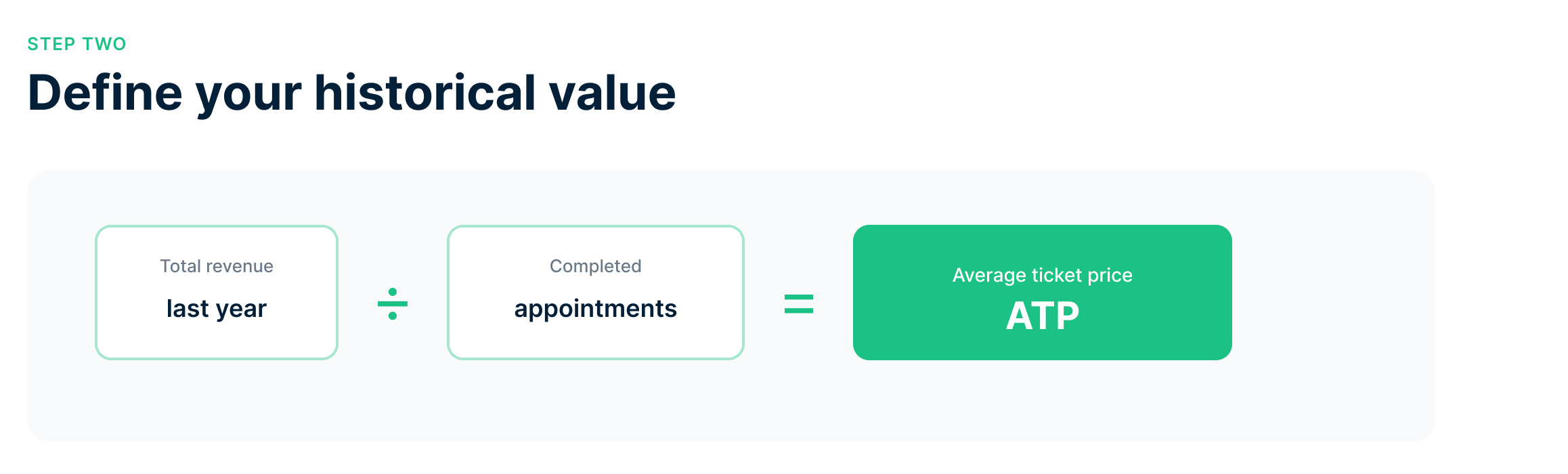
Step 2: Calculate Your Average Treatment Value
Add up the revenue, count the appointments, and divide one by the other.
A practical example. Say last year your clinic ran 1,560 completed appointments and brought in €312,000 in treatment revenue. That gives you an average treatment value of €200.
That €200 is your benchmark. On average, each appointment on your calendar is worth €200 to your clinic. Some are Botox follow-ups at €150, some are combination treatments at €700. The mix evens out over a year.
Step 3: Look at What Is Already Booked
Now flip the report around. Same export, but this time set the filter to planned appointments for the period you want to forecast. Two weeks ahead, the rest of the month, the next 60 days. Whatever horizon you actually plan against.
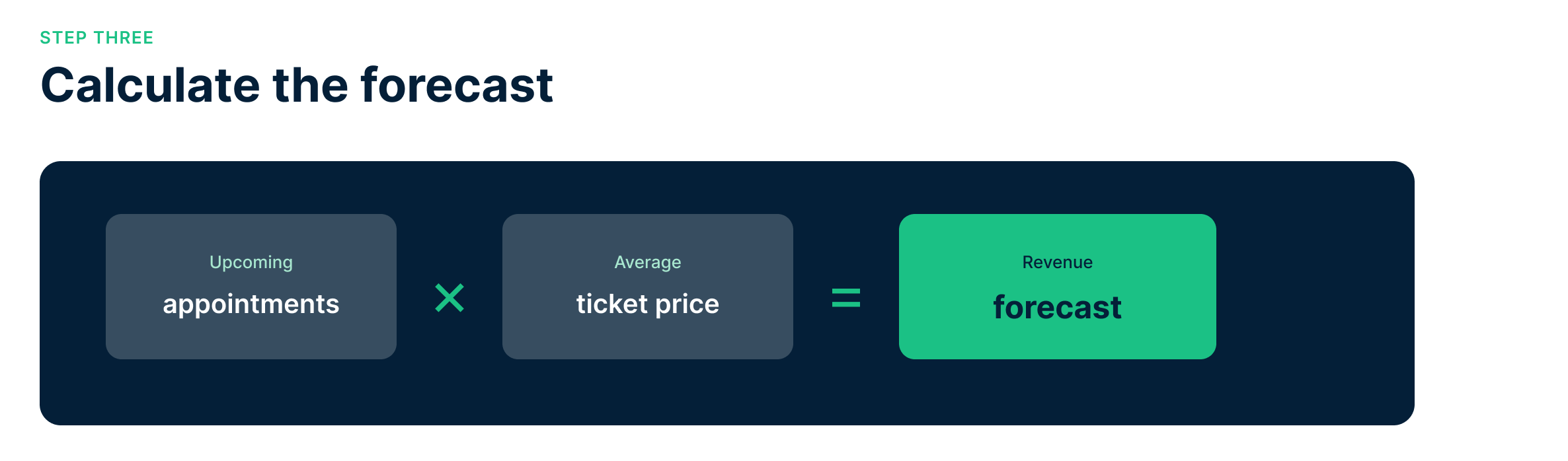
Multiply the count by your €200 average to get a forecast. A few examples from a real clinic mix:
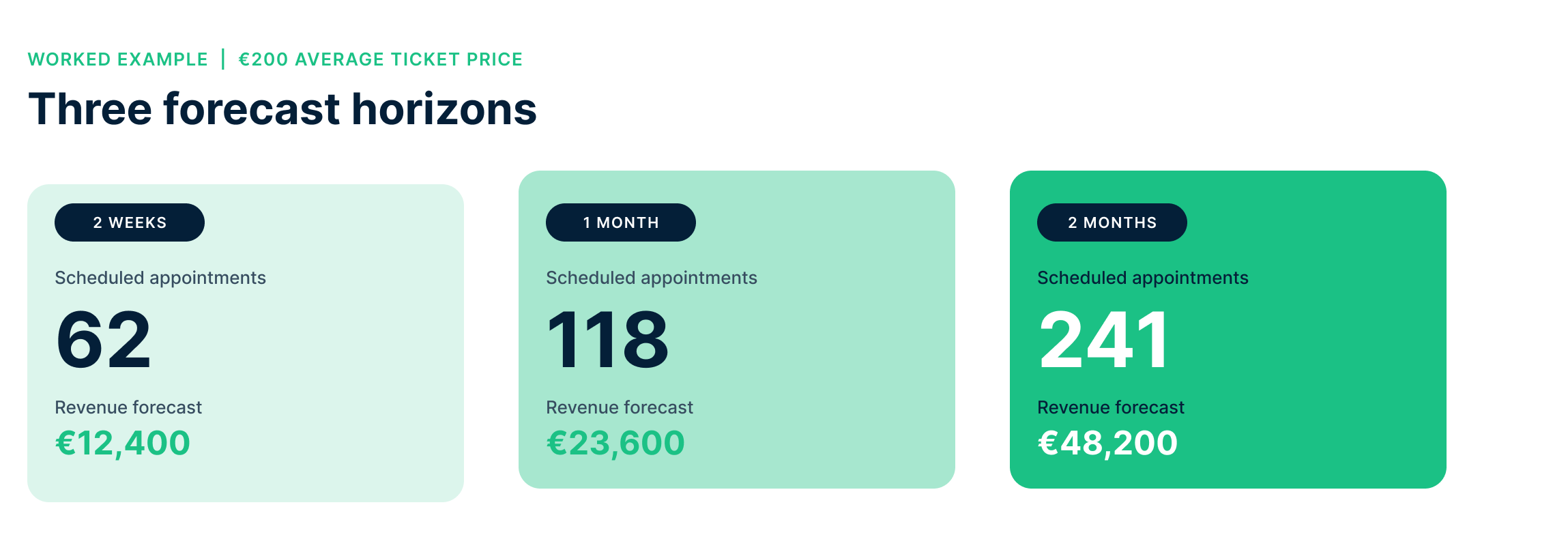 That is your starting point. No guesswork, no gut feeling. Just what is actually on the books.
Step 4: Subtract the Inevitable No-Shows
Aesthetic clinics live with this reality. Patients reschedule because they have a wedding next week and do not want to risk a bruise. They cancel last minute because of work. Some simply do not show up. In our data, 10-15% of planned appointments fall through.
So adjust the number down. If you want a conservative forecast, multiply by 0.85. If your clinic has strong reminder workflows and a deposit policy, 0.90 is more realistic.
Using the one-month example: 118 planned × 0.88 × €200 = around €20,768. That is a number you can actually plan against.
Step 5: Sanity-Check Against Reality
Two things will throw the average off, and you should adjust manually for both.
Seasonality. December in an aesthetic clinic does not look like August. December is gift cards, party-season prep, high-value packages. August is quieter and skews toward maintenance work. If you are forecasting a month that is structurally different from the yearly average, use the average treatment value from that same month last year instead of the rolling annual one.
Service mix. If you launched a new high-ticket treatment recently (PRP, RF microneedling, a new injectable), your historical €200 average is already too low. The opposite is also true. A campaign full of €99 introductory consultations will pull the average down for that period. Look at what is actually on the calendar before you trust the multiplication.
What This Buys You
Forecasting is not about being right to the cent. It is about walking into next month knowing roughly what is coming, so you can decide whether to push a campaign, hire that second injector, order more product, or hold off on the lease upgrade.
The five steps, one more time:
- Export 12 months of completed appointments and revenue
- Divide revenue by appointments to get your average treatment value
- Export planned appointments for the period ahead
- Multiply planned appointments by your average to get the forecast
- Apply a 10 to 15 percent no-show factor for the realistic number
Your calendar has been telling you this all along. You just needed the formula to read it.
Want to learn more or see Clinicminds in action? Chat with us directly.