
A Polish-speaking patient in Amsterdam finds your clinic through a Polish landing page. She clicks “Book now” and lands in a Dutch scheduler. The confirmation email is in Dutch. So are the medical questionnaire, the consent form and the aftercare instructions she receives after her treatment. The website promised a clinic that speaks her language. Everything after the click told her otherwise.
Most clinics that welcome international patients have solved the first step and none of the rest. A multilingual patient journey means every written touchpoint, from online booking to the invoice, reaches the patient in their own language. Below: what that is worth, what it costs to skip it, and which clinics stand to gain the most.
Aesthetic patients are customers and patients at once
Aesthetic treatment is elective and self-funded. Nobody is referred to you. People choose you, and they can choose someone else at any moment before they pay. That makes consumer research unusually relevant to our field.
CSA Research surveyed 8,709 consumers in 29 countries about buying online. 76% preferred products with information in their own language, and 40% said they would never buy from a website in another language. Good English didn’t remove the preference: 60% of the respondents most confident in English still wanted customer care in their native language, and 75% of all respondents said they were more likely to buy from the same brand again when that care came in their language.
An online scheduler is a checkout. If four in ten consumers walk away from a foreign-language webshop, it’s reasonable to assume that part of your international traffic leaves your booking flow for the same reason. You never see those people in your statistics, because they never became patients.
What happens when the journey switches language halfway
Consent that is signed but not understood
Consent is where a language gap stops being a marketing problem. The GMC’s guidance for doctors who offer cosmetic interventions requires clear, accurate information about the risks of a procedure. A consent form the patient can’t read properly gives you a signature without giving the patient that information.
Hospital research shows how quickly this slips. In a study at a US teaching hospital, charts of English-speaking patients were nearly twice as likely to include full informed consent documentation as those of patients with limited English: 53% versus 28%. A pilot study across six US hospitals found that adverse events in patients with limited English proficiency were more often linked to communication errors and more likely to result in harm.
These are hospital figures, not aesthetic clinic figures. The mechanism carries over, though. A patient who half-understands the risks of a filler treatment, or the aftercare instructions that follow it, is more likely to be alarmed by a normal side effect and slower to recognise an abnormal one.
Patients translate your forms themselves
Two thirds of the consumers in the CSA study use online machine translation. Your patients do the same with your documents: copy, paste, translate. They end up with a version of your consent form that you’ve never seen and can’t vouch for, and that version is the one they agreed to.
Reminders that don’t remind
NYC Health + Hospitals introduced automated appointment reminders in 14 languages. At its Coney Island location, the missed appointment rate in adult primary care fell from 26.9% to 20.8% across comparable periods. A rheumatology clinic at UCSF brought its no-show rate down from 24% to 11.6% after switching to reminders in its patients’ own languages. Both are public healthcare settings, and both are before-and-after comparisons, so don’t expect the same numbers in a private clinic. The principle holds anywhere: a reminder only works if the patient reads it.
Your front desk becomes the translation service
When the system speaks one language, your staff fill the gap. They explain the questionnaire by phone, send aftercare advice over WhatsApp in improvised wording, and answer the same questions twice. It costs time, and it makes your clinic inconsistent: every patient gets a slightly different explanation, and none of it is documented.
Where a multilingual patient journey pays off most
Language matters in more places than the obvious medical tourism destinations.
- Expat cities. Roughly nine in ten Dubai residents are expatriates. Eurostat counted 51.5% foreign-born residents in Luxembourg on 1 January 2025, 32% in Malta and 27.6% in Cyprus. In Ireland, Austria, Sweden and Germany, it’s more than one in five.
- Border regions. A clinic in Maastricht, Basel or Geneva draws patients from two or three countries within a half-hour drive.
- Multilingual countries. In Switzerland, Belgium and Luxembourg, your own compatriots don’t share one language.
- Medical travel destinations. ISAPS counted close to 38 million aesthetic procedures worldwide in 2024 and names Tunisia, the UAE, Colombia and Türkiye as the countries with the highest proportion of foreign patients. For these patients, the whole relationship before arrival is written and digital.
- Holiday and second-home regions. Clinics on the Costa del Sol or in the Algarve treat residents who have lived there for years without becoming fluent in the local language.
- Clinic groups across borders. One brand and one system, with patients in several languages.
Written and spoken language are two different problems
A systematic review of 33 studies in the Journal of General Internal Medicine found that, in the majority of situations, patients did better when their physician spoke their language. Software doesn’t replace that conversation. The consultation still needs a shared language or an interpreter.
What software can take care of is everything written, and that is where most of the journey happens. A patient spends twenty minutes in your treatment room and reads your words at home for days before and after. When the written part is right, the consultation is free for the questions that need a person.
Coming soon: Clinicminds Fluent
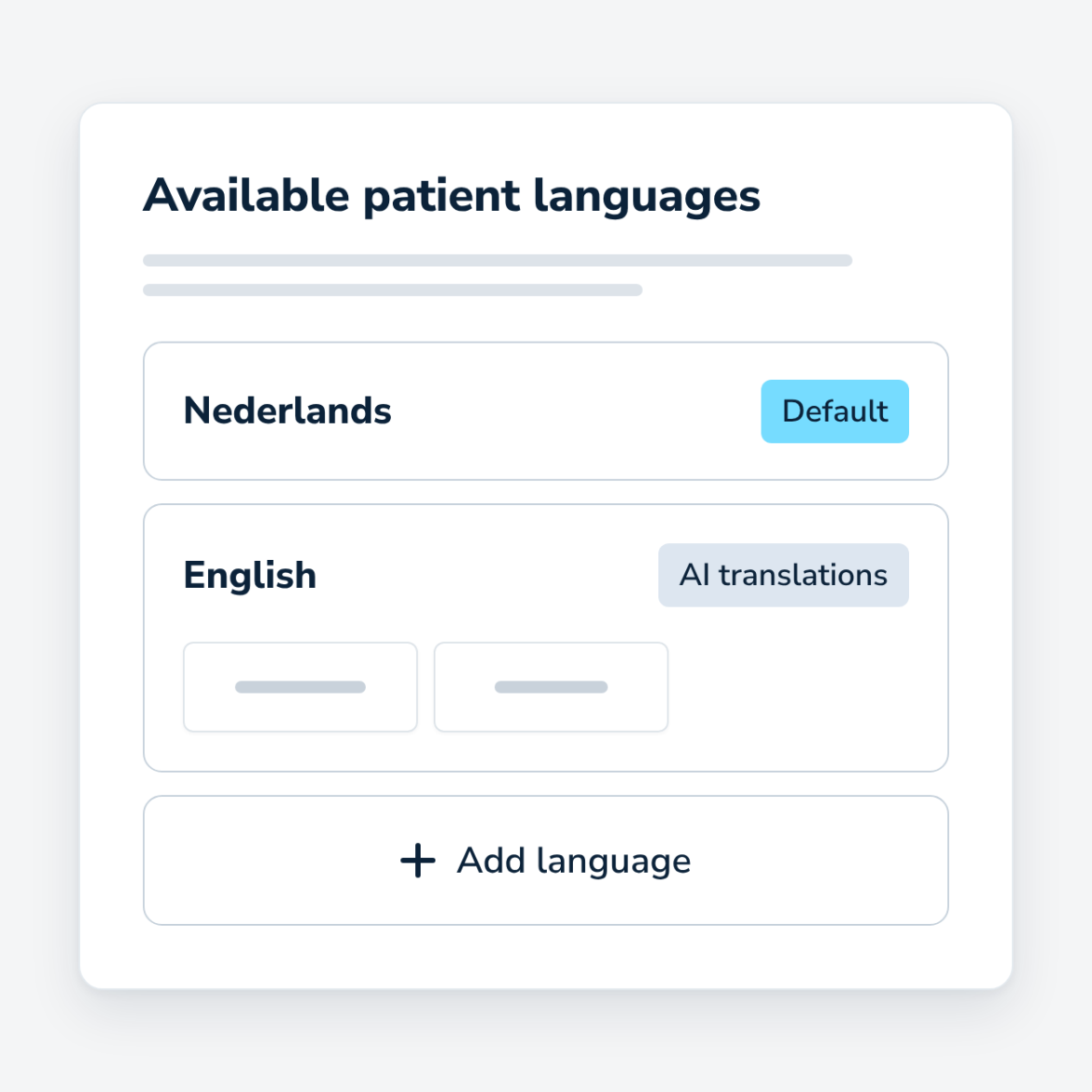
Our clinic software already runs in 12 languages for clinic teams. The patient side is next. Clinicminds Fluent builds a multilingual patient journey into the platform: online booking, confirmations and reminders, questionnaires, consent forms, aftercare instructions, invoices and the online gift card store, all in the patient’s language, while your team keeps working in its own.
Two things set it apart from a language dropdown. Add a supported language, and AI translates every patient-facing text in your account in one go, including the forms and messages you wrote yourself. And each patient gets a language profile, so from that moment, every message goes out in their language without anyone on your team having to think about it.
Their language. Your language. One journey.
More details follow shortly. Want to see how Clinicminds handles the patient journey today? Chat with us, and we’ll walk you through it.